What is purgatory?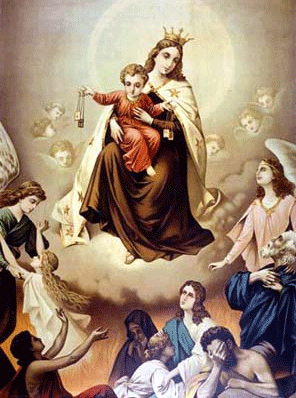
Purgatory is simply the place where already saved souls are cleansed of the temporal effects of sin before they are allowed to see the holy face of Almighty God. Revelation 21:27 tells us that “...nothing unclean will enter [Heaven].”
Purgatory is God’s way of ensuring that Revelation 21:27 is true and that nothing unclean will enter Heaven. It is only through Christ’s sacrifice that we are shown this mercy! It is Christ and Christ alone Who allows us access to the Father. Many people ask, “Where is the word purgatory in the Bible?” It will not be found in the Bible, but the concept of a “final cleansing” or “purgation” for those who require it is very evident in the Bible, in the writings of the early Church Fathers, and in the Old Testament religion whence Christianity sprang.
Daniel 12:2, Matthew 12:32, 1 Corinthians 3:13-15, 2 Timothy 1:16-18, Hebrews 12:14, Hebrews 12:22-23, 1 Peter 4:6 and Revelation 21:10, 27 all speak of purgatory in their telling of the need for purification, prayers for the dead, Christ’s preaching to the dead, and how nothing unclean will see God.
Tertullian says in his work, The Crown 3:3, dated A.D. 211: “We offer sacrifices for the dead on their birthday anniversaries.”
Cyprian of Carthage writes in A.D. 253: “It is one thing to stand for pardon, another thing to attain to glory; it is one thing, when cast into prison, not to go out thence until one has paid the uttermost farthing; another thing at once to receive the wages of faith and courage. It is one thing, tortured by long suffering for sins, to be cleansed and long purged by fire; another to have purged all sins by suffering. It is one thing, in fine, to be in suspense till the sentence of God at the day of judgment; another to be at once crowned by the Lord.”
St. Teresa of Avila interceding for the souls in purgatory The Church Fathers speak of purgation. 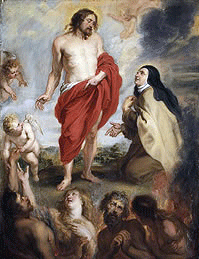 For examples, St. John Chrysostom in his Homilies on 1 Corinthians 41:5, A.D. 392, says: “Let us not hesitate to help those who have died and to offer our prayers for them.” And St. Augustine says in City of God, A.D. 419: “Temporal punishments are suffered by some in this life only, by some after death, by some both here and hereafter, but all of them before that last and strictest judgment. But not all who suffer temporal punishments after death will come to eternal punishments, which are to follow after that judgment.”
Archaeology also indicates the antiquity of the Christian belief in purgatory, the Final Theosis: the tombs of the ancient Christians were inscribed with words of petition for peace and for rest, and at the anniversaries of deaths, the faithful gathered at the graves of the departed to make intercession for those who had gone before.
Praying for the Dead
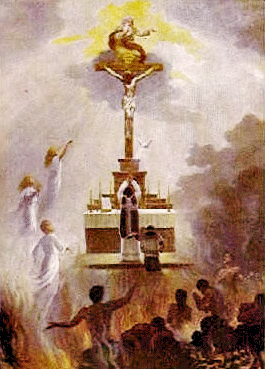
The Holy Sacrifice of the Mass freeing souls from purgatory “And making a gathering, he [Judas] sent twelve thousand drachms of silver to Jerusalem for sacrifice to be offered for the sins of the dead, thinking well and religiously concerning the resurrection (for if he had not hoped that they that were slain should rise again, it would have seemed superfluous and vain to pray for the dead) and because he considered that they who had fallen asleep with godliness, had great grace laid up for them. It is therefore a holy and wholesome thought to pray for the dead, that they may be loosed from sins.” – II Maccabees 12:43-46
 Those who have died in a state of grace are not truly “dead”; they are our beloved in Heaven or in purgatory (on their way to Heaven) and will forever be, world without end, part of the Communion of Saints – the Church Triumphant (the Saints in Heaven, whether or not they are beatified or canonized), the Church Suffering (the saints in purgatory, the holy souls), and the Church Militant (the saints on earth).
Because we cannot know, aside from those the Church has beatified or canonized, who is already in Heaven, who is in purgatory for a time, or who is damned, we pray for the dead for the rest of our lives, assuming they are in purgatory, while hoping they are in Heaven and not damned. We also ask those who have died to pray for us. While those whom the Church has deemed to be of the Church Triumphant (the canonized Saints) are in Heaven for certain and are, therefore, in no need of our prayers for them, we have always asked for them to pray for us. As to the Church Suffering in purgatory, St. Thomas Aquinas teaches that they are not able to know, by themselves, our prayers; however, it is piously believed, and taught by St. Alphonsus Liguori, that God makes our prayers known to them – not directly, as they are deprived of the beatific vision until they enter Heaven, but by infusing this knowledge into their souls. St. Bellarmine teaches that because the Church Suffering is so close to God – much closer than we are and having the great consolation of knowing they are saved – their prayers for us are very effective. So, as you pray for your dead loved ones and all the holy souls in purgatory, ask them to pray for you, too!
Languentibus in Purgatorio
(The Suffering Souls in Purgatory)
The suffering souls in Purgatory,
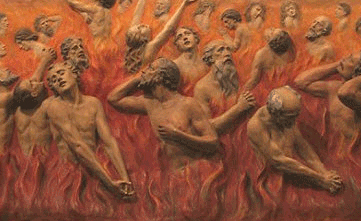
Who are being purified in excessive heat,
And are tormented by severe punishment,
Assist them, in your compassion, O Mary!
You are the open-wide fount who wash away the faults of men.
All you help, rejecting none:
Extend your hand to the Dead,
Who in pain languish continually, O Mary!
To you the souls of the Dead lovingly sigh,
Desiring to be rescued from pain
And to stand in your sight,
To possess eternal joys, O Mary!
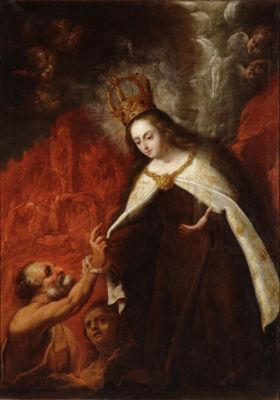
As they groan, hasten, Mother;
In mercy, show them your heart.
May Jesus through His wounds
Be pleased to heal them: ask this, O Mary!
You are true hope to them that call upon you.
The Holy Souls Sodality cry to you for their brethren.
Appease your Son, that in Heaven
He may give them their reward, O Mary!
Grant that the tears we shed at the feet of the Judge,
And which you regard with kindness,
May soon extinguish the avenging flames,
That the Holy Souls may join the choirs of Angels, O Mary!
And when the strict accounting takes place
In the terrible and awesome Judgment of God,
As He judges us, supplicate your Son,
That with the Saints may be our portion, O Mary!
Poem by Mother Mary of St. Austin
(Foundress of the Helpers of the Holy Souls)
O! It were bliss
After life’s plenitude of miseries
And death’s alarms
To lie within the everlasting arms
Awakened by God’s kiss.
Heaven’s joy were all in this,
To lose all pain and dread,
And be thus comforted
By Love’s own kiss – the kiss that wakes the dead.
For He Himself will wipe away all tears;
The pent-up grief of years
Shall sob itself to rest
Childlike, upon His breast.
With more than mother’s love
He shall caress
And bless
With joys, all joy above,
The comfortless.
Earth could not weep
To pass through death’s eclipse,
Could she but know Whose lips
Would raise her from that sleep.
Ye, who have understood,
Be not afraid,
Nor dread
It is God’s Kiss – God’s kiss that wakes the dead.
© 2010 Carmelite Monastery