
Information on the Stations of the Cross or the Way of the Cross
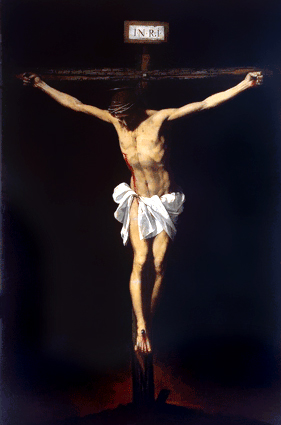 1.Jesus is condemned to Death
2.Jesus is made to carry His Cross
3.Jesus falls the First Time
4.Jesus meets His Sorrowful Mother
5.Simon of Cyrene helps Jesus to carry His Cross
6.Veronica wipes the Face of Jesus
7.Jesus falls the Second Time
8.The Women of Jerusalem weep over Jesus
9.Jesus falls the Third Time
10.Jesus is stripped of His Garments
11.Jesus is nailed to the Cross
12.Jesus is raised upon the Cross and Dies
13.Jesus is taken down from the Cross
14.Jesus is laid in the Sepulchre
The object of the Stations is to help the faithful to make in spirit, as it were, a pilgrimage to the chief scenes of Christ’s sufferings and death, and this has become one of the most popular of Catholic devotions. It is carried out by passing from Station to Station with certain prayers at each and devout meditation on the various incidents in turn. It is very usual, when the devotion is performed publicly, to sing a stanza of the “Stabat Mater” while passing from one Station to the next.
Inasmuch as the Way of the Cross, made in this way, constitutes a miniature pilgrimage to the holy places at Jerusalem, the origin of the devotion may be traced to the Holy Land. The Via Dolorosa at Jerusalem (though not called by that name before the sixteenth century) was reverently marked out from the earliest times and has been the goal of pious pilgrims ever since the days of Constantine. Tradition asserts that the Blessed Virgin used to visit daily the scenes of the Passion of Christ, and St. Jerome speaks of the crowds of pilgrims from all countries that used to visit the holy places in his day.
It cannot be said with any certainty when indulgences for visiting the holy places began to be granted, but most probably they may be due to the Franciscans, to whom in 1342 the guardianship of the holy places was entrusted. A desire to reproduce the holy places in other lands, in order to satisfy the devotion of those who were hindered from making the actual pilgrimage, seems to have manifested itself at quite an early date.
Realizing that comparatively few persons were able to gain these by means of a personal pilgrimage to the Holy Land, Innocent XI, in 1686, granted to the Franciscans, in answer to their petition, the right to erect the Stations in all their churches and declared that all the indulgences that had ever been given for devoutly visiting the actual scenes of Christ’s Passion could thenceforth be gained by Franciscans and all others affiliated with their order if they made the Way of the Cross in their own churches in the accustomed manner. Innocent XII confirmed the privilege in 1694 and Benedict XIII in 1726 extended it to all the faithful. In 1731, Clement XII still further extended it by permitting the indulgenced Stations to all churches, provided that they were erected by a Franciscan father with the sanction of the ordinary. At the same time, he definitely fixed the number of Stations at fourteen. Benedict XIV in 1742 exhorted all priests to enrich their churches with so great a treasure, and there are few churches now without the Stations.
There is some uncertainty as to what are the precise indulgences belonging to the Stations. It is agreed that all that have ever been granted to the faithful for visiting the holy places in person can now be gained by making the Via Crucis in any church where the Stations have been erected in due form.
In 1773, Clement XIV attached the same indulgence, under certain conditions, to crucifixes duly blessed for the purpose, for the use of the sick, those at sea or in prison, and others lawfully hindered from making the Stations in a church. The conditions are that, whilst holding the crucifix in their hands, they must say the “Our Father” and “Hail Mary” fourteen times, then the “Our Father”, “Hail Mary”, and “Glory Be” five times, and the same prayers once each for the pope’s intentions.
In conclusion, it may be safely asserted that there is no devotion more richly endowed with indulgences than the Way of the Cross and none which enables us more literally to obey Christ’s injunction to take up our cross and follow Him. A perusal of the prayers usually given for this devotion in any manual shows what abundant spiritual graces, even apart from the indulgences, may be obtained through the devotion. The fact that the Stations may be made either publicly or privately in any church renders the devotion suitable for all. - Excerpted from the Catholic Encyclopedia
Benefits of Meditation on the Passion of Christ
Meditation on the Passion of Our Lord is one of the most important parts of our Spiritual life, and it is this that the Stations of the Cross is meant to achieve. As the rosary unites us to Christ in all the important mysteries of His life, so the Stations (another Marian devotion), unite us even more particularly to each moment of His passion. It is a beautiful practice that Christians have clung to since the first days of Christianity. Let us hear what some of the greatest Saints have said about this practice:
“If you wish to advance in your spiritual life, think of the Lord’s sufferings every day, because by thinking of It, it is impossible not to be overwhelmed with love capable of making other effects relative when compared to his own, and strength to overcome with joy the inevitable burdens and trials of life.” – St. Alphonsus de Liguori
"He who desires", says St. Bonaventure, "to go on advancing from virtue to virtue, from grace to grace, should meditate continually on the Passion of Jesus." And he adds that "there is no practice more profitable for the entire sanctification of the soul than the frequent meditation of the sufferings of Jesus Christ."
"The most holy Passion of Jesus Christ is the most efficacious means to convert obstinate sinners." – St. Paul of the Cross
But especially I commend earnest mental prayer to you, more particularly such as bears upon the Life and Passion of our Lord. If you contemplate Him frequently in meditation, your whole soul will be filled with Him, you will grow in His Likeness, and your actions will be molded on His. He is the Light of the world; therefore in Him, by Him, and for Him we shall be enlightened and illuminated.- St. Francis de Sales
Christians must lean on the Cross of Christ just as travelers lean on a staff when they begin a long journey. They must have the Passion of Christ deeply embedded in their minds and hearts, because only from it can they derive peace, grace, and truth. - St. Anthony of Padua
Do not pass one day without devoting a half hour, or at least a quarter of an hour, to meditation on the sorrowful Passion of your Saviour. Have a continual remembrance of the agonies of your crucified Love, and know that the greatest saints, who now, in heaven, triumph in holy love, arrived at perfection in this way. - St. Paul of the Cross
The remembrance of the most holy Passion of Jesus Christ is the door through which the soul enters into intimate union with God, interior recollection and most sublime contemplation...- St. Paul of the Cross
There is no practice more profitable for the entire sanctification of the soul than the frequent meditation of the sufferings of Jesus Christ. - Saint Alphonsus de Liguori
Stations of the Cross Crucifix
Way of the Cross Triptych
Books
© 2008 Carmelite Monastery
