 The word “Advent” comes from the Latin word adventus which means “coming”. The focus of Advent is preparation for the coming of the Lord, both in commemoration of His Nativity and His coming again at the end of time. Though many people see this time of year as a part of the Christmas season, it is not; the Christmas season does not begin until the first Mass at Christmas Eve and does not end liturgically until the Octave of the Epiphany on January 14.
The mood of the Advent season is one of somber spiritual preparation that increases in joy with each day. So the worldly “Christmas” commercialism that surrounds it in the Western world should be overcome as much as possible. We should strive to keep the liturgical season of Advent holy, penitential, reflective, and prayerful, always remembering, as they say, that “He is the reason for the Season.”
Advent, then, is above all a time of joyful anticipation. During Advent, emphasis is placed on the reading of Old Testament prophecies of the coming of the Messias. These beautiful and illuminating texts fill the Divine Office and Masses of Advent, and they may also be read by the faithful during the season. The themes followed by the church during the liturgical season of Advent are often called “The Last Things” – death, hell, heaven and judgment. The color of the season is violet and, as during Lent, all flowers are removed from the church with the exception of the Advent wreath.
The first Sunday of the Advent season also marks the beginning of the Church’s liturgical year. The first Sunday is the one on or nearest St. Andrew’s Day, November 30. Because the secular calendar changes from year to year, the first Sunday may fall on any day between November 27 and December 3. The season can also vary from 22 to 28 days in length, ending on Christmas Eve. It always contains four Sundays. Advent originated as a time of preparation for people entering the church family, prior to their baptism on Epiphany, January 6. Between the fourth and seventh centuries, the season varied from three to as many as seven weeks in different parts of Christendom. During this time, Advent came to be seen as a time of preparation for all believers in anticipation of Christmas. The Church eventually set the season’s length at four Sundays in the sixth century.
Doctrinal Note
The whole of the Advent liturgy is one of pressing appeal for the coming of the Savior. The cries of ardent longing which went up to the Messias throughout Old Testament times are taken up again by the Church, who puts them on our lips and causes us to repeat them ever more urgently as Christmas draws near.
Our Savior has come, of course, but we still await Him. For ourselves and for our own times, we await His graces of redemption and sanctification, which are to transform our human lives to the likeness of His. For ourselves and all the generations of mankind which are to follow one another on the earth, we await at the end of time the glorious return of Christ, the Redeemer of the world, Who will lead, with Himself, all the elect into the kingdom of His Father. The long-awaited Messias is King, not only of His own people Israel, but of all nations. He is God’s own Son, become man to save all men.
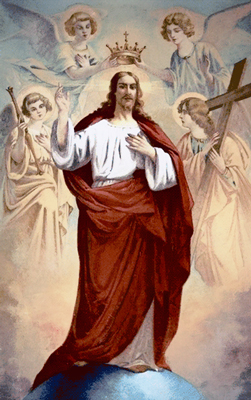 We should ardently desire this twofold coming of Christ, representing grace for this life here below and glory in the world to come. Our Lord’s Incarnation is the source of all Christian hope. As the Church prepares us to celebrate His coming into this world as an event of the past, she calls on us to work with her for the extension of His kingdom in the expectation and unconquerable hope of His second coming.
The time of waiting which separates us from this final achievement is given to the Church to proclaim the good news of salvation to the ends of the earth. The liturgy of this season is arranged around the three great figures of Isaias, St. John the Baptist, and the Blessed Virgin Mary. Through their providential roles, there is recalled in wondrous fashion both the remote and immediate preparation by God of the salvation that He promised to the world after the sin of our first parents.
Isaias is the great Advent prophet. In the eighth century before Christ, at the most difficult period of Jewish history, he calls on the people to trust in God alone and await the salvation of the Messias which is to come. After a time of harsh exile, the Messias will save His people, the remnant of Israel, will cause peace and perfect justice to reign over the world, and will spread abroad knowledge of the true God among all nations.
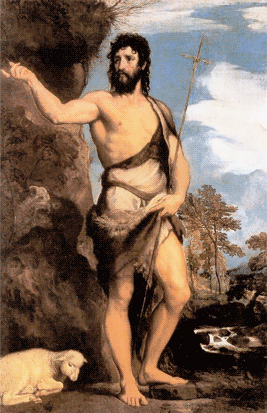 John the Baptist, the last of the prophets and the first witness to the coming of the Messias, shows Christ to us and earnestly calls on us to go out to meet Him: “Behold the Lamb of God, behold Him Who takes away the sin of the world.” John’s message is one of penance and of the need for conversion.
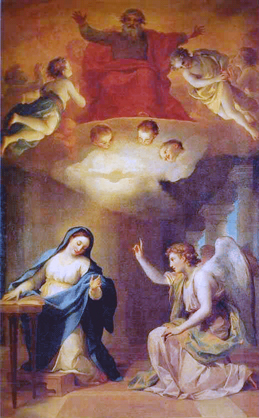
Lastly, the Blessed Virgin Mary, our Savior’s Mother, in whom the mystery of grace is accomplished with unequalled fullness before it is extended to the rest of mankind, by her faith and acceptance of God’s plans for her personifies the Church’s expectancy and welcome of Christ. May the urgent appeals of the great prophet, the Precursor’s exhortations, and the Blessed Virgin Mary’s intercession prepare us to celebrate the Birth of our Savior with the fervent love which inspired them in the face of God’s plan for the salvation of the world.
The Advent Wreath
The lighting of the Advent wreath is a familiar custom during this season in churches and in homes. On the first day of Advent, Catholic families will set up the simple wreath, formed usually of evergreen branches and adorned with candles, typically three violet-colored and one rose-colored to match the priest’s vestments on each of the days the candles are lit. (A later custom is to add a single white candle to the middle of the wreath on Christmas Eve. This is called the Christ Candle.) Each day at home, the candles are lighted, perhaps before the evening meal – one candle the first week and then another each succeeding week until December 25th. The increasing light shed by the candles represents our increasing joy as the day of Jesus’ coming approaches.
The rose pink candle is lit on the third Sunday of Advent, known as Gaudete Sunday, gaudete meaning “Let us rejoice”. Church vestments and altar frontals are also changed from purple to rose pink on this Sunday.
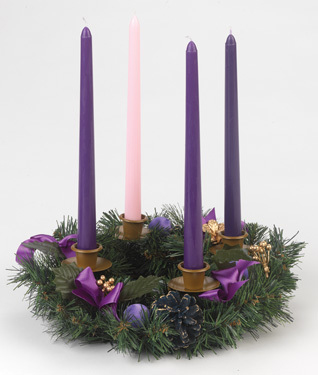 As with most customs in the Church, the Advent wreath is full of symbolism and is a means for explaining the Christmas story. The circle of the wreath reminds us of God Himself, His eternity, His love and endless mercy, which has no beginning or end. The green of the wreath speaks of the hope that we have in God, which is the hope of newness, of eternal life. Candles symbolize the light of God coming into the world through the birth of his Son. The light reminds us that Jesus is the Light of the World that comes into the darkness of our lives to bring newness, life, and hope. It also reminds us that we are called to be a light in the world ourselves, reflecting the light of God’s grace to others. The colors of the candles are typically violet and rose and symbolize penance and moderated joy, respectively.
The progression in the lighting of the candles symbolizes the various aspects of the time of our waiting. The candles are lit over the four week period, reminding us of the four centuries of waiting between the prophet Malachi and the birth of Christ, and in symbol we also see the darkness of fear and hopelessness receding and the shadows of sin falling away as more and more light is shed into the world.
The first candle also recalls the Patriarchs; the second candle recalls the Prophets; the third candle recalls St. John the Baptist; and the final candle recalls Our Lady. The flame of each new candle reminds us that something is happening and that more is yet to come.
Finally, the light that has come into the world is plainly visible as the Christ Candle is lit at Midnight Mass on Christmas Eve, and we rejoice that the promise of long ago has been realized.
At midnight on Christmas Eve or on Christmas Day, many people have the custom of replacing the purple and pink candles with white ones. The greenery of the Advent wreath can now be decorated with holly and other ornamentation and turned into a Christmas wreath for use throughout the Christmas season. The white candles symbolize our joy at the coming of Christ and our prayers of thanksgiving to God. This Christ Candle is used until the Epiphany (January 6) or Candlemas (February 2), depending on the family’s particular Christmas customs.
Advent Wreaths and Candles
Advent Calendars
© 2008 Carmelite Monastery